
Thailand Automotive Industry Update – 2026
Thailand Automotive Industry Update – 2026
Thailand Accelerates EV Regulations and Certification Ecosystem to Strengthen Its Position as ASEAN's Automotive Hub
July 2026 has been another significant month for Thailand's automotive industry. Government agencies introduced several major regulatory initiatives covering electric vehicle (EV) standards, battery lifecycle management, emissions regulations, and testing infrastructure. Together, these developments signal Thailand's transition from investment promotion toward building a comprehensive regulatory ecosystem that supports long-term industrial growth and international competitiveness.
July 2026 | Thailand Significantly Expands Mandatory EV Standards

In July 2026, Thailand's Industrial Product Standards Committee approved five additional Thai Industrial Standards (TIS) as mandatory standards for the electric vehicle industry, representing one of the country's most significant regulatory developments in recent years.
The newly approved mandatory standards cover:
·Portable EV Charging Cables
·AC Charging Equipment
·DC Fast Charging Equipment
·Occupant Protection in Frontal Collision
·Occupant Protection in Side Collision
These standards will be implemented in phases, with portable EV charging cables and AC charging equipment expected to become mandatory by June 2027, followed by DC fast charging equipment and vehicle crash protection standards in early 2028.
In parallel, mandatory standards for EV traction batteries and electric motorcycle batteries are already scheduled to take effect by March 2027, further expanding Thailand's regulatory framework for the EV industry.
With these additions, Thailand is rapidly increasing the number of mandatory EV-related standards, extending regulatory oversight beyond vehicles themselves to include charging infrastructure, battery safety, and occupant protection. The objective is to enhance consumer safety, improve confidence in the EV market, prevent low-quality imported products from entering the country, and strengthen Thailand's competitiveness as a regional EV manufacturing hub.
July 2026 | Thailand Strengthens Battery Lifecycle Management
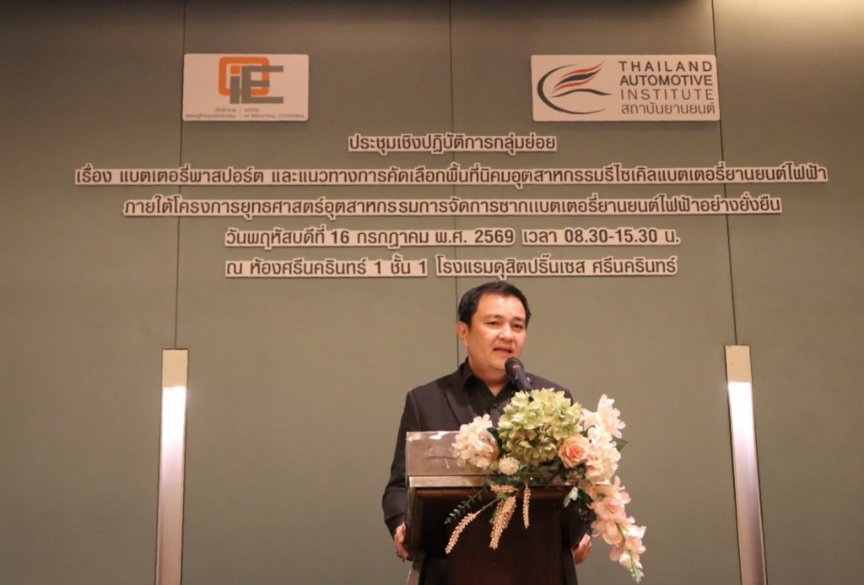
Thailand is also accelerating the development of a comprehensive battery management ecosystem.
The Department of Industrial Works (DIW) has proposed new regulations to control imports of used EV batteries based on their State of Health (SOH).
Under the proposal:
·Batteries with SOH above 80% may be imported for repurposing or second-life applications under specified conditions.
·Batteries with SOH between 60–80% may only be imported for stationary energy storage systems (ESS) within industrial facilities.
·Batteries with SOH below 60% will generally be classified as waste and be subject to strict import restrictions or prohibition.
At the same time, the Thailand Automotive Institute (TAI) is developing a Battery Passport system that enables battery traceability throughout its entire lifecycle—from manufacturing and vehicle operation to second-life applications and recycling.
TAI is also studying suitable industrial zones for future EV battery recycling facilities, supporting Thailand's Circular Economy policy and preparing the country for the growing volume of end-of-life EV batteries in the coming years.
Together, these initiatives demonstrate Thailand's commitment to building a complete battery ecosystem rather than focusing solely on EV manufacturing.
9 July 2026 | Thailand Advances Euro 5 Standards and Motorcycle Exhaust Regulations
On 9 July 2026, the Thai Industrial Standards Institute (TISI) held a meeting with representatives from the Japan Automobile Manufacturers Association (JAMA) and the Thai Automotive Industry Association (TAIA) to discuss upcoming automotive standards.
One of the key topics was the revision of TIS 341-2543 for motorcycle exhaust systems, which aims to strengthen emission control and consumer protection.
The meeting also focused on Thailand's progress toward implementing Euro 5 emission standards. TISI expects the technical standards to be completed within 2026, after which the related ministerial regulations can be issued.
During the discussion, TAIA expressed concerns regarding the readiness of testing laboratories and certification bodies, noting that additional preparation time may be required before the new regulations become mandatory.
The dialogue reflects Thailand's efforts to align domestic regulations with international environmental standards while ensuring a practical transition for manufacturers, laboratories, and certification organizations.
Industry Outlook
The recent developments indicate that Thailand's automotive policy is entering a new phase. Rather than focusing solely on attracting EV manufacturers, the government is establishing a comprehensive regulatory ecosystem that covers the entire automotive value chain—from battery lifecycle management and charging infrastructure to vehicle safety, emissions standards, and testing capabilities.
For automotive manufacturers, component suppliers, importers, and certification service providers, regulatory compliance will become increasingly important over the next few years. As new mandatory standards and certification requirements continue to expand, companies that prepare early will be better positioned to access the Thai market and maintain long-term competitiveness.






Please first Loginlater ~